The global heat pump market is undergoing a swift development. The low-carbon renovation for constructions is implemented continuously in every country, while the increase of energy cost pushes end users to abandon the fossil-fuel boilers, and the networks of distributors and installers are expanding continuously in both mature and emerging markets. However, whether distributors, contractors, or project developers, they will face the same core question: which one is better, the air-to-air heat pump or the air-to-water heat pump?
This article is to explain the difference between two heat pumps and applicable selection advice, aiming to help you match the combination of products for the destination market.
I. What are air-to-air and air-to-water heat pumps?
Air-to-air heat pump
An air-to-air heat pump transfers heat directly between outside air and indoor air without water circulation pipes. Its indoor terminal unit adopts wall-mounted units, ceiling cassette units, fan coil units, etc., supplying cold and hot air to the room directly. However, the equipment itself does not generate hot water, and the user needs to equip an individual electric water heater or fuel water heater to supply daily hot water.
Air-to-water heat pump
An air-to-water heat pump absorbs heat from the outside air and transfers heat to the water. Connected to the ground heater, low-temperature radiators, fan coil units, or domestic hot water storage tanks, the heated water circulates inside the water piping works. This belongs to a central hydronic heating system, aiming to replace the gas, oil, or electric boilers. The cooling function is optional, and the system cannot blow cold air directly.
II. Comparison
| Comparison Item | Air-to-Water Heat Pump | Air-to-Air Heat Pump |
| Heat transfer medium | Water-based (hydronic piping circuit) | Refrigerant + Air |
| Domestic hot water | Can be integrated to provide heating | No built-in hot water function |
| Heating terminals | Underfloor heating / Radiators / Fan coil units | Indoor units blow warm air directly; they support zoned temperature control. |
| Cooling capacity | Optional (requires fan coil units) | Standard heating and cooling capabilities |
| Initial investment | Higher (includes main unit + water tank + piping + terminal units) | Lower overall cost (for a system with one outdoor unit and multiple indoor units) |
| Installation complexity | Complex; longer installation time; requires a hydronic heating technician | Simple installation and fast construction, primarily involving the routing of refrigerant piping |
| Operational comfort | Radiant heating; gentle temperature rise; no drafty airflow | Rapid room heating, though direct airflow may be noticeable |
| Seasonal Performance Factor (SPF) | Higher efficiency during continuous whole-house heating | Performs well for zoned heating and cooling |
| Space requirements | Requires space for a buffer tank / hot water tank | No water tank required, saving indoor space |
| Suitability for retrofitting existing buildings | Best suited for retrofitting homes with existing hydronic piping systems | Better suited for apartments, studio units, and buildings without water-based piping systems |
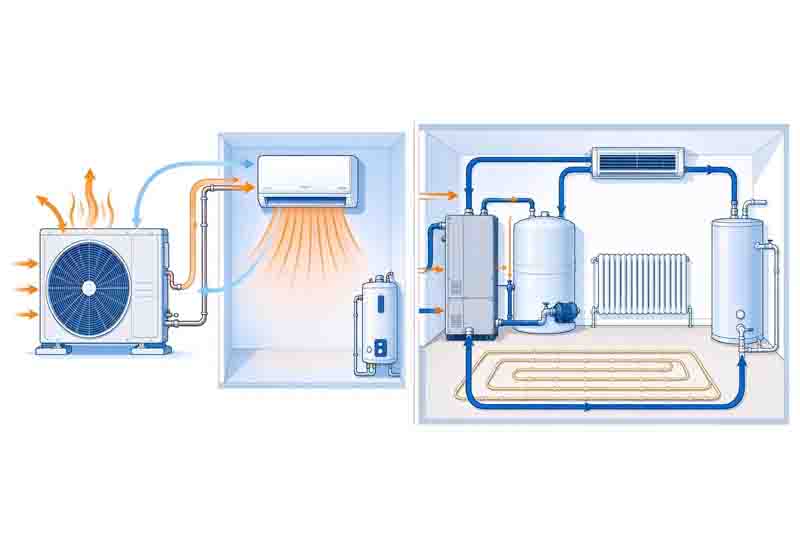
III. Pros and Cons
Air-to-air heat pump
Advantages:
- Lower initial cost, quick installation, and suitable for apartments, townhouses, and small commercial projects.
- Individual control for plug-and-play cooling and heating: each room temperature can be set separately.
- Retrofitting is straightforward, requiring no complex water piping infrastructure.
- It is more popular in high-temperature areas where the cooling demand is more than heating.
- Easy installation; a normal AC technician can finish the installation without additional training courses.
Shortcomings:
- It cannot provide hot water.
- Direct airflow will lead to a draft sensation and fluctuate the indoor humidity.
- An additional water heater will increase the energy consumption and add more electricity bills.
- It is not well-suited for whole-home, large-area heating regions.
Air-to-water heat pump
Advantages:
- One system could achieve whole-room heating and hot water supply without additional water heating devices.
- With ground heating or radiant heating, low-temperature radiators provide even temperatures without draught, offering superior comfort.
- It is very suitable for the European market that relies on water heating.
- With the appropriate model, the heat pump supplies heating continuously in regions with cold winters, performing good energy efficiency in long-term operation.
Shortcomings:
- The initial cost for equipment, a water tank, and piping work is high.
- Longer installation time, and the technician should be certified with a license in plumping and heating.
- Additional spaces for water tanks are needed.
- The heating for the whole piping network takes time; the response time for space heating is slow.
- Heating with fan coil units is the additional function, which increases the cost.
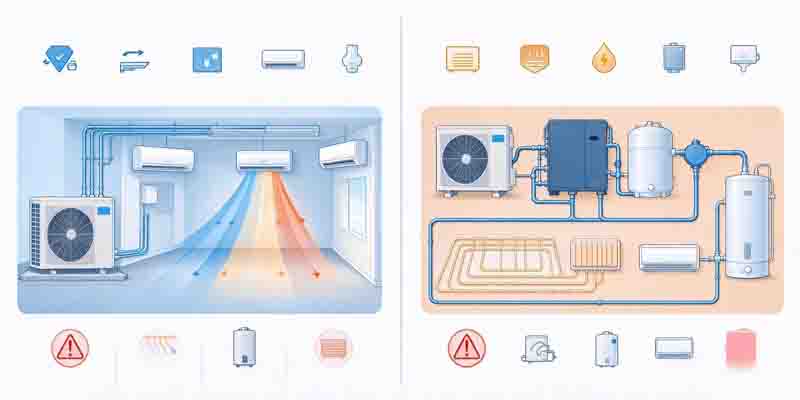
IV. Choose the model based on the marketing trend.
Choosing an air-to-water system when:
- The existing houses are equipped with radiators or piping works for ground heating.
- Policy subsidies are available for boiler replacement and renewable energy-based heating systems.
- The demand for a system supplying space heating and hot water at the same time.
- Cold winter with long heating-supply period.
- Stress on long-term comfort and acceptance of the initial high cost.
- Centralized heating supply projects like new villas, large houses, hotels, and so on.
Choosing an air-to-air system when:
- Cooling and heating demand coexist, and even more require cooling.
- buildings without piping works.
- less investment and quick completion.
- apartments and single-room renovations.
- and large temperature differences and major power loads for cooling.
There is not a "best" solution for a heat pump, but the best suited to the market.
Air-to-water heat pump systems are a key low-carbon solution for replacing boilers; they are well-suited for users who require both central heating and domestic hot water and are prepared for a higher initial investment.
Air-to-air heat pump systems are the primary volume drivers in the heating and cooling market. They are ideal for regions with hot climates or significant temperature fluctuations, as well as for apartment projects, catering to customers who seek a dual-purpose heating and cooling solution that is cost-effective and quick to install.
FAQ
Q1: What is the core difference between air-to-water heat pumps and air-source fluorine heat pumps?
A1: The core difference lies in the heat exchange medium. Air conditioners use refrigerant (Freon) for direct air cooling, while chillers employ water as a secondary heat exchange medium, where refrigerant first heats or cools the water before transferring the thermal energy via water circulation
Q2: For home use, is a water source heat pump or a fluorine heat pump better?
A2: For those prioritizing constant temperature comfort, quiet operation, compatibility with underfloor heating and domestic hot water, and long-term use, the water source heat pump is preferred. For those with limited budgets, seeking quick heating/cooling, simple installation, or small spaces, the fluorine heat pump is the better choice.
Q3: Can both types of heat pumps work properly in low-temperature areas?
A3: There are low-temperature models available. A low-temperature water machine with antifreeze solution (antifreeze and electric auxiliary heating) is less likely to frost and affect indoor temperature; Temperature fluctuations are prone to occur indoors during low-temperature defrosting of fluorine machines.