Heat pumps have become the mainstream solution for heating, cooling, and domestic hot water among global constructions. However, there is no universal heat pump model suitable for all climate conditions. Issues like decreased heating performance, shut-off under high temperature, frequent malfunctions, and increasing energy consumption appeared in the post-purchasing-project era, rooted not in the quality of the equipment but in the unreasonable selection based on local climate conditions.
The extreme low and high temperatures, air humidity, and salt-spray corrosion in different areas will directly determine the selection of heat pump units, compressing technology, refrigerant, IP class, etc. This purchasing guide divides the selection logistics by climate divisions, giving out a checking list before purchasing and aiming to help avoid selection risks.
I. Step 1: Collect local climate parameters.
Before sending an inquiry, it is necessary to keep the following 4 climate data in hand, which are the fundamentals:
The designed lowest ambient temperature in winter: This determines the heating capacity under low ambient, which is the key index for extreme cold areas.
The highest ambient temperature in summer: This is important for tropical and desert areas, which determine the cooling capacity under extreme hot ambient (T3 condition).
Average annual relative humidity: Anti-corrosion and dehumidification performance is taken into consideration in humid and rainy areas.
Special environment conditions: An improved corrosion-resistance level for unit casing and heat exchanger is necessary for coastal areas with salt spray and areas with sand, dust, and high altitude.
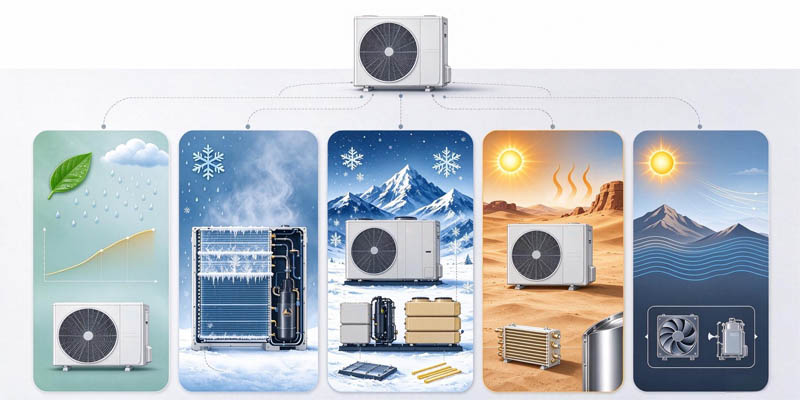
II. Match the heat pump units by climate divisions.
1. Mild climate zone (winter ≥ -5°C, summer 30–35°C).
This climate features little extreme cold in winter and no extreme heat in summer with a high annual humidity and relatively balanced cooling/heating loads.
Recommended model: Standard inverter air source heat pump (dual-generation/tri-generation, cooling + heating + domestic hot water).
Note: If the temperature in the region sometimes decreases below -5℃, it is recommended to keep a supplementary heat source (firewood, electric heating).
2. Humid-cold climate zone (winter temperatures of -5°C to -15°C; summers characterized by high heat and high humidity).
This climate features not too low temperatures in winter but high air humidity, a damp-cold body sensation, and frequent frost and muggy and humid summers with a high demand of cooling and heating loads.
Recommended model: EVI (Enhanced Vapor Injection) low-temperature air-source heat pumps (prior choice: dual-function heat pump units for both heating and cooling).
Not: An EVI compressor is a must, and the intelligent defrost logic is necessary for reducing the temperature fluctuation and energy consumption surges.
3. Extremely cold climate zones (winter temperatures below -15°C with extreme -30°C to -40°C).
This climate features a long period of heating supply with the challenge of low ambient temperature. Traditional heat pumps will halve their heating performance and even shut down.
Recommanded model: Ultra-low-temperature EVI heat pumps.
Note: It is recommended to choose larger capacity models. Don’t just look at a unit’s rated "operable down to -35°C" specification without considering its actual heating capacity at that temperature. Many models can start up at such temperatures, but their heat output is severely insufficient to meet actual heating demands.
4. Tropical / Hot Desert Climate Zones (high temperatures all year round, with extremes of 43–52°C).
This climate features a whole year of heating with a demand for cooling only. Extreme hot temperatures will easily lead to the compressor's high-temp protection mechanism and reduction of cooling performance.
Recommended model: T3 version units, supplying cooling and domestic hot water.
5. High-altitude regions.
This climate features thin air, which reduces heat-exchange efficiency and heat dissipation.
Recommended model: Announce the actual altitude in advance so the manufacturer would adopt adjustments on the fan motor and compressor accordingly. Traditional heat pump units are not applicable.
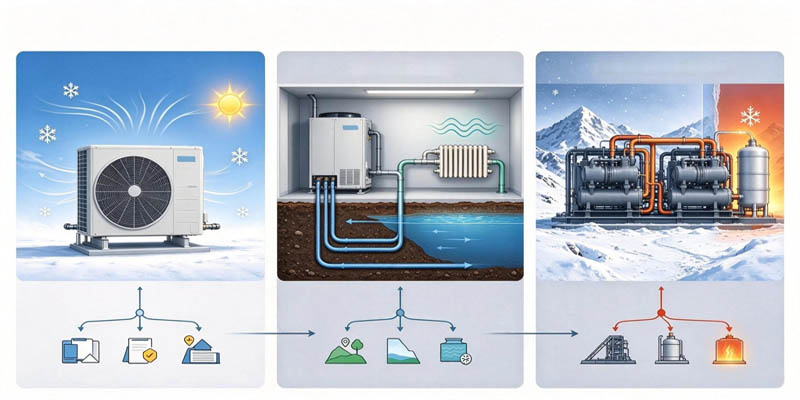
III. Types of heat pumps
Air source heat pump: easy installation, low investment, widely spread worldwide. This type of heat pump is deeply influenced by the ambient temperature, which needs to be selected by climate conditions and is suitable for residential and small-middle commercial projects.
Ground source/water source heat pump: stable ground water temperature without interface of climate conditions and with a high energy efficiency annually. However, the initial cost for construction is high, and due to the limitation of the space, this is mostly suitable for premium commercial and Vella projects.
Cascade heat pumps: Designed specifically for extreme cold conditions, these systems offer higher outlet water temperatures but entail greater procurement and maintenance costs; they are typically used for large-scale projects in severely cold regions.
IV. Misunderstandings
1. Referencing the rated COP only and omitting the performance under extreme conditions.
The rated COP is a standard test under normal ambient temperature. It cannot represent the actual performance at the coolest point in winter and the hottest point in summer.
2. Wrong capacity selection.
Small size will lead to insufficient cooling/heating performance during the coolest/hottest period, and the set temperature can not be reached. Larger size will lead to frequent start-ups and a decrease of energy efficiency, resulting in accelerated wearing of the equipment.
3. Omit the corrosion around the environment.
Models used for land areas are not suitable for coastal areas. The heat exchanger will rust and perforate within 1-2 years.
4. Mismatch between terminal units and heat pump.
When pairing an ultra-low-temperature heat pump with high-temperature radiators, the outlet water temperature must be verified; otherwise, the system may fail to provide sufficient heat.
The purchasing of heat pump units is not just simply by power consumption and brand; the climate condition is the prior principle. Fix the local extreme temperature at the early project stage, and choose the proper heat pump unit with the relative climate condition so we can assure the stable operation of the whole system, control the long-term electricity bill, and reduce the aftersales issues.