For decades, water filtration has been built around a simple idea: make the filter pores small enough to keep unwanted particles out. This principle remains important, but modern drinking water filtration is becoming more complicated.
Today, consumers are increasingly concerned about not only visible sediment and particles, but also microorganisms, heavy metals, PFAS, volatile organic compounds (VOCs), and trace organic contaminants. Different contaminants behave differently in water, which means that particle size alone cannot explain how effectively a filter can remove them.
This is where advanced filtration materials are attracting attention. Instead of relying exclusively on smaller pores, electropositive filter media introduce another mechanism: electrostatic attraction and adsorption.
For modern household appliances such as a countertop cold water dispenser, this difference can matter. The goal is not simply to create a finer filter, but to balance contaminant removal, flow rate, pressure drop, and everyday usability.
The Limitation of Conventional Mechanical Filtration
Traditional mechanical filtration primarily works through physical retention. When water passes through a porous material, particles larger than the effective openings are more likely to be captured.
The intuitive assumption is therefore:
Smaller pores = better filtration.
But the relationship is not that simple.
As filtration pores become smaller, hydraulic resistance can increase. A filter designed for extremely fine mechanical separation may require greater pressure to maintain an acceptable flow rate. In household water filtration, this creates a practical trade-off between filtration efficiency and water delivery.
This is particularly relevant to a countertop water dispenser, where users expect filtered water to be available without waiting excessively long for every glass.
Elarisey™ takes a different approach from conventional filtration media. Rather than relying solely on pore size to capture contaminants, it combines a multi-layer filtration structure with positive-charge adsorption, allowing water to interact more thoroughly with the media and supporting the reduction of a broad range of contaminants.
That distinction is important because a 2 μm nominal pore size should not be interpreted as meaning that the material can only interact with contaminants larger than 2 μm.
What Is Electropositive Filtration?
The key idea behind an electropositive filter is relatively simple: use surface charge as another filtration mechanism.
Elarisey's technical principle is based on natural mineral fibers whose crystal structure generates a positive electrokinetic potential on the fiber surface. Under the specified freshwater conditions of approximately pH 5–9.5, the material is designed to maintain positive charge and attract negatively charged contaminants.
This changes the filtration question.
Instead of asking only:
How large is the contaminant?
the system can also consider:
How does the contaminant interact with the charged filter surface?
Electrostatic interactions are already recognized in water-treatment science as one of the mechanisms involved in adsorption and contaminant removal. The effectiveness of adsorptive media, however, depends on the specific material, contaminant, and water chemistry.
That is why electropositive filtration should not be understood as a universal mechanism that removes every contaminant simply because it is negatively charged. Rather, it provides an additional interaction mechanism alongside physical retention and depth filtration.
Why Depth Filtration Matters
A filter is not simply a flat screen.
Elarisey uses a refined multi-layer filtration structure that creates extensive filtration space within a compact material. This structure provides a larger effective contact area, allowing water to interact more fully with the filtration media and supporting efficient contaminant adsorption and retention while maintaining practical water flow.
This layered structure creates a deeper filtration path.
As water travels through the material, particles and microorganisms can encounter multiple layers rather than a single surface. At the same time, electrostatic attraction can contribute to the retention of negatively charged particles that may be difficult to address through simple size-based screening alone.
In simplified terms:
|
Conventional mechanical filtration |
Electropositive depth filtration |
|
Primarily relies on physical retention |
Combines physical retention and electrostatic attraction |
|
Strongly influenced by pore size |
Uses pore structure plus surface charge |
|
Finer pores can increase pressure drop |
Designed to maintain filtration with lower pressure |
|
Mainly surface/size-based separation |
Multi-layer depth filtration |
The purpose is not to eliminate mechanical filtration, but to make the filtration mechanism less dependent on pore size alone.
From Particles to Microorganisms
Bacteria, viruses, and cysts are not simply particles that can be evaluated by looking at their physical dimensions. Their surface characteristics and interactions with filtration media can also influence retention.
Elarisey provides strong microbial reduction performance and can achieve a high level of microbial control under applicable conditions, offering an additional layer of protection for drinking water filtration. Its filtration mechanism helps reduce the risk of microbial contamination and supports water treatment performance across a range of applications.
It is important to use the correct terminology here.
Removal is not necessarily the same as killing.
The value of an electropositive filter is its ability to capture and retain microorganisms through a combination of filtration and adsorption mechanisms, rather than claiming that the material itself disinfects water.
This distinction becomes especially important when discussing advanced drinking water filtration technologies.
Modern Water Filtration Has to Address More Than One Type of Contaminant
The next generation of water filtration is also being shaped by the increasing diversity of contaminants that consumers care about.
Heavy metals, for example, behave differently from microorganisms. Organic micropollutants behave differently again. There is no single filtration mechanism that should automatically be assumed to provide the same removal performance for every contaminant.
Elarisey is designed to provide effective reduction of a broad range of common contaminants, including heavy metals, with removal performance reaching ≥99% under applicable conditions. Its advanced filtration structure supports consistent contaminant reduction while maintaining practical flow performance.
Elarisey technology also supports the reduction of PFAS, PFOS, PFOA, and other emerging contaminants. Actual performance may vary depending on filter design, material configuration, water quality, and operating conditions.
This is one reason advanced filtration should be evaluated by specific contaminant claims and test conditions, rather than by pore size alone.
Does Electropositive Filtration Replace UF or RO?
Not necessarily.
Different technologies solve different water-treatment problems. Ultrafiltration and reverse osmosis are pressure-driven membrane processes, while electropositive media rely on a combination of depth filtration and surface interactions.
|
Technology |
Primary mechanism |
Typical role |
|
Mechanical filtration |
Physical retention |
Particles and sediment |
|
UF |
Membrane separation |
Microorganisms and fine particles |
|
RO |
Pressure-driven membrane separation |
Broad dissolved contaminant reduction |
|
Electropositive media |
Depth filtration + electrostatic adsorption |
Microorganisms, particles and selected contaminants |
Elarisey can operate at approximately 0.5 bar or under gravity-driven flow, offering a low-pressure alternative to filtration technologies such as UF and especially RO, which typically require higher operating pressures.
This lower-pressure characteristic is particularly relevant for point-of-use appliances. A countertop water filtration system does not necessarily need to be designed like a high-pressure RO system to provide meaningful filtration. Its design priorities can instead include adequate contaminant removal, stable flow, low pressure drop, and convenient daily operation.
Why This Matters for a Countertop Cold Water Dispenser
The technology inside a filter ultimately has to work in a real product.
For a household countertop water dispenser, filtration performance cannot be considered separately from the user's experience. A filter that delivers excellent laboratory separation but severely restricts flow may create a very different experience from a filter designed to balance filtration and hydraulic performance.
Elarisey's technical data emphasizes low-pressure operation, high flow, and high dirt-holding capacity through its multi-layer structure.
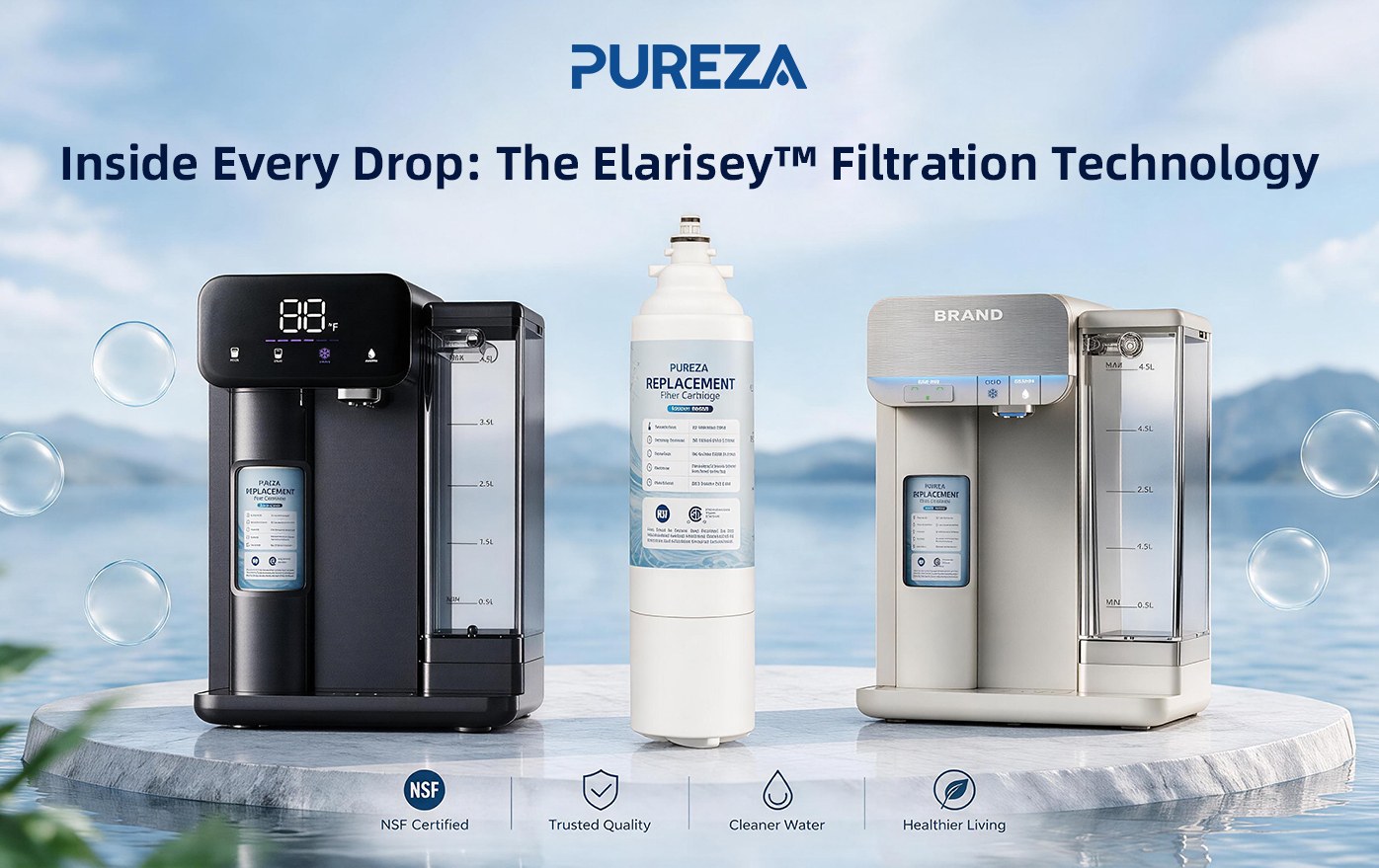
This approach is used in Pureza's Z035N filter media for the PU-T02 and PU-T03 countertop cold water dispenser platforms.
The objective is straightforward: bring a more advanced filtration mechanism into a compact household appliance without making everyday water dispensing unnecessarily complicated.

The Future of Water Filtration Is More Than Smaller Pores
The next generation of drinking water filtration is unlikely to be defined by one number on a specification sheet.
A smaller pore size can be useful, but it is only one part of filtration science. Modern filter design increasingly considers surface chemistry, electrostatic interactions, depth filtration, contaminant characteristics, pressure, flow rate, and filter capacity together.
Elarisey's positive-charge mineral fiber technology represents this different design philosophy. Rather than relying exclusively on increasingly fine mechanical barriers, it combines a multi-layer filtration structure with positive-charge adsorption to create another pathway for contaminant retention.
For technologies such as the countertop cold water dispenser, this balance is especially relevant. The future of household water filtration is not simply about making filters finer.
It is about making filtration more purposeful: using the right combination of physical and electrostatic mechanisms to address increasingly complex water-quality challenges while maintaining practical everyday performance.